
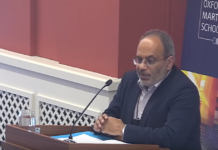

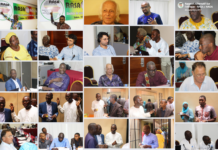
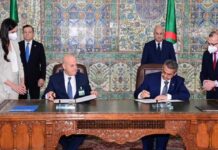












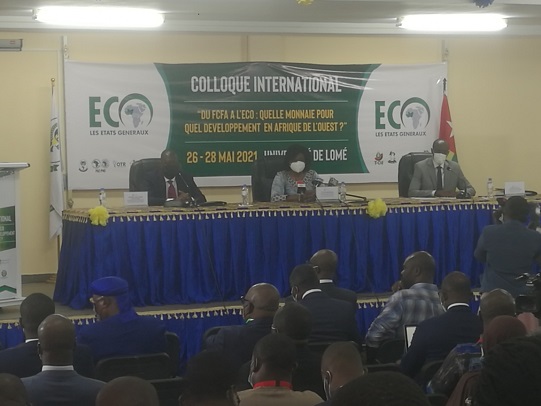
From 26 to 28 May 2021, an international colloquium was held on the ECO, the new currency that is supposed to replace the CFA. Organised by the Faculty of Economics and Management (FASEG) of the University of Lomé, the conference brought together several people in person and by videoconference on the theme: « From the CFA to the ECO: what currency for what development in West Africa? The conference was attended by about a hundred participants from several African and Western countries, including economic and political leaders, economic and currency experts, specialists from different disciplines, business leaders, academics, students, etc., as well as several thousand people who followed the exchanges online.
The meeting in Lomé provided an opportunity to reflect on the transition to ECO and the urgency of Africa’s development. This reflection led to the definition of a roadmap, on 28 May 2021, a date which marks the 46th anniversary of the creation of ECOWAS. At the end of the meeting, a declaration called the « Lomé Declaration » was drawn up around four (4) main axes:
- the major objectives of the reform project which are, on the one hand, to associate all the States, whatever their differences, by guaranteeing the necessary flexibility to absorb the impacts of external shocks which may diverge, and on the other hand, to maximise the potential of increased and reinforced economic integration.
- Fundamental choices, such as a sound exchange rate policy, short-term convergence criteria, a loosening of the inflation constraint, structural convergence or the implementation of sectoral policies
- The future system which will be built on a new currency, sui generis, distinct from the existing currencies in the ECOWAS zone, with the eventual transition from a common currency to a single currency.
- the implementation modalities with the adoption of a transitional period towards the common currency, during which a first pool of States meeting the minimum convergence criteria (which will have to be updated) may meet. Subsequently, new memberships in the project will be sought by looking for those that are easier to obtain.
The Lomé Declaration, which is the contribution of the ECO General Assembly to the monetary reform envisaged in the ECOWAS zone, will be submitted to the Heads of State and Government of the zone, according to a press release issued by the Dean of FASEG, Mawuli Kodjovi COUCHORO.
The Lomé Declaration (28 May 2021)
A roadmap for the creation of the Eco-Cedeao currency
A. Major aims of the reform project
- Since the decision of the Ecowas Heads of State Summit of 20 June 2019 in Abuja, the principle of the Ecowas currency has been established. The political process towards the adoption of a common currency responds to a legitimate demand for the establishment of full monetary sovereignty of the 15 Member States.
- The project is in line with the post-Covid perspective of regaining all fundamental sovereignties (food, health, trade, financial, political, security) at the regional level.
- The project takes note of the decision to leave the Franc Zone taken by 8 States at the end of 2019, notably with the repatriation of currencies from the operating account domiciled in France and the choice of a new currency denomination, the Eco.
- The project aims to associate all the States, whatever their differences, by guaranteeing the necessary flexibility to absorb the impacts of external shocks, which may diverge.
- Finally, the project aims to maximise the potential of increased and strengthened economic integration.
B. On the fundamental choices
- The project takes into consideration the criteria of a good exchange rate policy, namely financing essential imports, supporting exports, promoting local credit, protecting « emerging sectors » with high employment potential, and offsetting the negative impacts of external shocks.
- On the short-term convergence criteria (prices, debt, deficit), the draft recognises the need to set minimum macroeconomic criteria (entry ticket) for membership, but above all the draft considers that the elimination of differentials (prices, debt, deficit) is not a prerequisite, but a medium-term objective, made easier to achieve with an adequate economic policy.
- A loosening of the inflation constraint (4-8%) is required so as not to restrict the potential for structural transformation. Moderate inflation stimulates credit because it reduces debt for borrowers. It rewards innovation.
- In doing so, structural convergence is fundamental and sectoral policies in favour of regional agricultural and industrial value chains need to be implemented in a complementary manner.
C. On the future system
- The new system will be built on a new currency, sui generis, distinct from the existing currencies in the ECOWAS zone.
- A Central Bank would be responsible for conducting the monetary and exchange rate policy of the member countries of the ECOWAS zone.
- The pooling of foreign exchange reserves shall be the basis for solidarity.
- During the transition period, solidarity will be reinforced on a political and institutional basis. A cooperation mechanism will be put in place to mitigate differences of opinion and facilitate economic convergence.
- The definition of the future Eco-Cedeao currency shall be based on a basket of currencies representative of the main trade flows of the Zone, with four currencies, the Euro, the Dollar, the Yuan and the Pound Sterling.
- The exchange rate of the common currency will be flexible but administered by the Central Bank.
- An exchange rate agreement shall be concluded between the parties for the pegging of their existing currencies to the Eco-Cedeao currency, which shall serve as a pivot. The principle of a corridor will be adopted within which existing currencies can float around the central currency with a fixed fluctuation margin monitored by the Ecowas monetary authority.
- Eventually, the transition from a common currency to a single currency will be envisaged.
D. On the modalities of implementation
- Particular attention will be paid to the prospects of monetary digitalisation.
- To initiate the transition to the common currency, an initial pool of States meeting the minimum convergence criteria (which will have to be updated) may meet. Subsequently, new memberships in the project will be sought by looking for those that are easier to obtain.
- The abandonment of the French Treasury guarantee granted to WAEMU states will be decided.
- Confidence in the Eco-Cedeao currency will be based on new endogenous safeguard and credibility mechanisms.
- During the transition and learning phase of the exchange rate mechanisms, attention will be paid to fiscal and budgetary approximation and the stimulation of regional financial markets, both of which are necessary conditions.
- Finally, it is clearly recognised that behind the questions of how to create the new currency, the future parity and its peg to a basket of currencies, the level of exchange rate flexibility or the « right » currency allocation regime to be adopted, lie other crucial issues, namely engaging in the structural transformation of West African economies.
- To bring about real change, proposals to accompany the transition to Eco-Cedao will have to be technically sound, economically justified, politically accepted and based on measures whose future impacts and risks will be assessed in advance. The issue of recognising the benefits of monetary integration and sharing them in order to gain the support of the populations is fundamental to the success of the project.
Done in Lomé, on 28 May 2020, the Etats généraux de l’Eco
Source: Opera News