
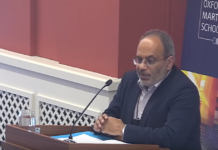





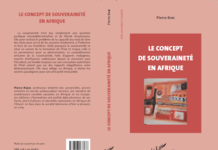








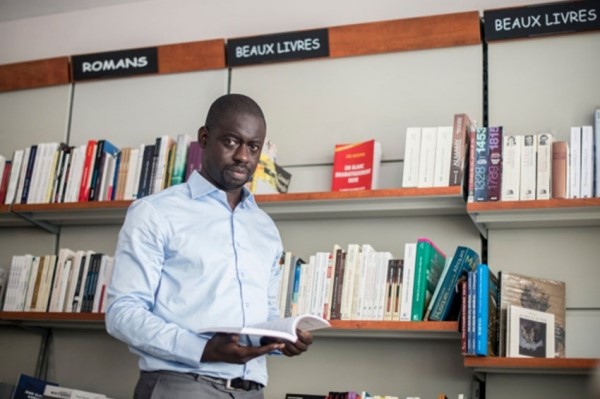
Economist, novelist, essayist, Felwine Sarr is currently one of the most prominent African thinkers. In this interview with Intelligences Magazine, he talks about his latest book, Afrotopia, and about the Ateliers de la Pensée recently held in Dakar, which he initiated with Cameroonian politician Achille Mbembé.
In Afrotopia, your latest book, you talk a lot about the decolonization of the imaginary and the questioning of the concept of development. Can you come back to these themes developed in the book?
Yes, in fact, if we look closely, all our social dynamics are guided by a teleology. The ultimate project is to develop the countries. All the logorrhea, all the phraseology revolves around development. We would be underdeveloped and we must develop, it is the imperative of the march of our societies. When one examines this concept and its archaeology, one realizes that it is a concept with strong ideological connotations. It was forged at a given time and responded to given facts. We were in a post-World War II world with an East-West divide and the Americans wanted a concept that would unite them. They came up with the concept of underdevelopment to say that from now on, they were going to help all underdeveloped nations to develop. This was in a speech by President Truman. As a result, all the dynamics of social adventures were erased in favor of a single model whose benchmark was the United States.
http://intelligences.info/article-660-felwine-sarr-crivain-conomiste.html

<!– /* Font Definitions */ @font-face {font-family: »Cambria Math »; panose-1:2 4 5 3 5 4 6 3 2 4; mso-font-charset:0; mso-generic-font-family:roman; mso-font-pitch:variable; mso-font-signature:-536869121 1107305727 33554432 0 415 0;} @font-face {font-family:Calibri; panose-1:2 15 5 2 2 2 4 3 2 4; mso-font-charset:0; mso-generic-font-family:swiss; mso-font-pitch:variable; mso-font-signature:-469750017 -1073732485 9 0 511 0;} /* Style Definitions */ p.MsoNormal, li.MsoNormal, div.MsoNormal {mso-style-unhide:no; mso-style-qformat:yes; mso-style-parent: » »; margin-top:0cm; margin-right:0cm; margin-bottom:8.0pt; margin-left:0cm; line-height:107%; mso-pagination:widow-orphan; font-size:11.0pt; font-family: »Calibri »,sans-serif; mso-ascii-font-family:Calibri; mso-ascii-theme-font:minor-latin; mso-fareast-font-family:Calibri; mso-fareast-theme-font:minor-latin; mso-hansi-font-family:Calibri; mso-hansi-theme-font:minor-latin; mso-bidi-font-family: »Times New Roman »; mso-bidi-theme-font:minor-bidi; mso-fareast-language:EN-US;} .MsoChpDefault {mso-style-type:export-only; mso-default-props:yes; font-family: »Calibri »,sans-serif; mso-ascii-font-family:Calibri; mso-ascii-theme-font:minor-latin; mso-fareast-font-family:Calibri; mso-fareast-theme-font:minor-latin; mso-hansi-font-family:Calibri; mso-hansi-theme-font:minor-latin; mso-bidi-font-family: »Times New Roman »; mso-bidi-theme-font:minor-bidi; mso-fareast-language:EN-US;} .MsoPapDefault {mso-style-type:export-only; margin-bottom:8.0pt; line-height:107%;} @page WordSection1 {size:612.0pt 792.0pt; margin:70.85pt 70.85pt 70.85pt 70.85pt; mso-header-margin:36.0pt; mso-footer-margin:36.0pt; mso-paper-source:0;} div.WordSection1 {page:WordSection1;} –>
What was the consequence?
Creativity, the multiplicity of trajectories, the diversity of value chains, everything has been reduced to a single project with great conviction because under the term development we put all the virtuous aspirations of human groups: prosperity, well-being… Whereas all societies necessarily need to respond to the aspirations of the group, but the forms of response are multiple and varied. History has given us several forms, and Western-style development is only one of them. Western-style development is the product of a lived history. These societies by trial and error, contingencies, arrived at these states. We are in the field of the social where the same causes do not produce the same effects and where the historical adventures are singular and do not reproduce themselves identically. There was an agricultural revolution, an industrial revolution in England. There was a whole historical and contingent context that allowed us to arrive at these forms. And even the people who worked on them did not know that they would end up with these forms. One cannot ask a group to put on a societal ready-made form, a form completed elsewhere, resulting from another dynamic outside of its own history without creating its own dynamic, without reaching the end of its internal dynamic. This is why, as long as we have a vision of mimicry, we will get nowhere. The nations that have dared not to mimic, that have dared to take singular paths, that have dared to take their history into account, that have dared to provide answers adapted to their context, are the ones that are doing best. It is in this sense that the aspirations of groups must be reviewed. This does not mean setting aside virtuous aspirations or failing to meet challenges. It means acknowledging that this is a highly ideological concept. It is not a teleonomy for everyone.
In your opinion, what are the contours of the alternative model?
It is a model that must already reflect on the meaning of the social adventure and on its finalities. We can’t run around without asking ourselves what kind of society we want. In society, what are the balances we want to establish. What is the place of politics, culture and the arts? When, in a society, people think about working time and say that we must work 35 hours, it is because they have developed a reflection on leisure, on another time, outside of productivity, so that people can devote themselves to something other than working to live, living to work.This means that there is a reflection on the relationship to work, on the relationship to time and on the use of time. Of course, we have to work to support ourselves, but once we have a sufficient amount of work in the social group, what do we do with the rest of our time? Fundamentally, this is a civilizational question.
Does this mean that the economy is not a panacea?
The economy is an order of means, it is a technical order, it is like a car, it is like an engine. You build the engine of an airplane, you have to ask yourself where do you want to go? How far do you want to go? Once you have these answers, you say I make this type of plane, this type of engine. We are in the tyranny of orders. The lower orders, the technical orders, have taken over from the higher orders. Instead of asking the question of the meaning of the social adventure, of the finality first. Once we have agreed on the type of social contract, we explore the technical ways and means to implement it. We put the technical orders in front for purposes that they cannot take in charge. This is the confusion in which we live.Now when people say « growth rate », we are obliged to add « inclusive growth » because we have realized that producing wealth is largely insufficient. The question is how it is produced, how it is distributed, who benefits from it, for what purposes. But if 10% of the social group benefits from it and 90% does not, what sense does it make? So all the semantic enrichment, over the last fifteen years, around growth rates or inclusive growth denotes a concern for meaning. That is the real question. Globalization: what are we globalizing? Globalization: what are we globalizing? This is where Africa can contribute a great deal, Africa has provided a great deal of individual and collective responses to the shocks it has experienced over the past five years. The continent has been resilient, it has great social engineering. It knows how to integrate differences, it knows how to live together, and it has been able to respond to unprecedented situations throughout its history. At a time when the crises we are experiencing are first and foremost crises of meaning and significance, it is in fact already providing solutions every day.Here are people who have been forced to adopt systems that were not their own, value systems, modes of economic production, institutions; people who have survived all of this, who have shown inventiveness, creativity. There are a lot of resources in everyday life that we do not question, that we do not think about, that we do not theorize. We have an extraverted look. We always look at how our societies look like they should. They must be modern, postmodern and so on. And then we look for these signs in our experience. But what our experience proposes to us and which is outside these categories that have been posed as teleological categories, we do not observe. We are in a form of semi myopia. We only see what is valued elsewhere. All the forms of living together that are there, that do not obey any concept, in an indicator where we are not the first to be classified, we do not see them. This is what Achille Mbembe calls the indocile matter of the continent, which refuses to enter into frameworks that are standardized elsewhere. And it is there its true ground, its true creativity. But we are in an economy of lack, instead of starting from what we have to build the real, we continue to read our real in relation to what we would lack.
Where does this attitude come from?
It is a psychological and mental attitude that is the result of centuries of denial, of epistemic violence. Colonialism, in order to take root and to last, did not only need the military, the merchants, it needed to depreciate our frameworks of production of meaning and significance, to denigrate them and to convince us that other frameworks were more operative and the way to realize oneself and to rise in humanity was to be an absolutely perfect copy or to be even much more so than the colonist. And everything that this continent has produced as meaning, as sense for millennia, is put aside. It is even absolutely stupid. How can we think that societies that have lived for millennia have not transmitted an intellectual, cultural, cognitive capital to provide answers to living together? How could they have done to exist and last. These societies have resources within them that have allowed them to be sustainable. There are groups that have disappeared. For me what is fundamental is the glasses with which we look at our reality. We are confronted with difficulties like everyone else, but we have the annoying tendency to reduce our being in the world to difficulties that some people have magnified. And some wanted to make believe that these difficulties summarized everything. And we have accepted to be locked in small criteria, in simplistic economism. And everything that makes our added value we don’t look at. That’s why, as an economist, I have the impression that the urgency is not in the economic programs. The urgency is in the reconstruction of the psychic infrastructures and in the reconstruction of the glance on oneself. Avoiding the pitfall of apology and denigration, I have the impression that this is what is urgent and that the rest is less difficult to solve as a problem.
The two can go together …
It is not one without the other. This is what I experience in my work. I supervise many theses that students defend, we answer clear, precise and concrete problems with precise recommendations on precise questions. But this is not enough. If you want to set up a public policy, you have to take into account everything else. This answer you bring in how it makes sense to people, how it fits with the other aspirations of the human group. How it is articulated and that is the global reflection.
With Achille Mbembé, you have initiated Les Ateliers de la Pensée, the first edition of which was held in Dakar in October.
At the beginning, we had started with the project of doing a cross-reading of our two books. While discussing, we said to ourselves that these last years we felt like a renewal of the African critical thought of French expression. And when we say critical thinking, we do not limit ourselves to theoretical texts. We saw that in literature, in artistic expressions, people were exploring other forms, shifting the gaze, changing the discourse, renewing conceptual categories. And these are things that I find in the work of a choreographer, in the work of a novelist and in some theoretical texts. We said to ourselves that perhaps the categories from which we looked at our reality were being reinterrogated by a certain number of researchers, thinkers, African artists and those of the diaspora. And so we said to ourselves that perhaps it would be good to get together and take stock of this critical thinking that seems to be in motion and to release ideas, concepts, forms to think about the present and the future that we want to give ourselves. And probably, this could not be an individual and solitary activity. We wanted to try to make a thinking-together bloom in its tensions and contradictions. We were convinced that if we got together, something would emerge. We were going to realize mutually that there were new paths to open. That was the idea: to renew the way we look at things, the conceptual frameworks through which we consider ourselves, to take charge of our reality through thought. We are generally subjects of thought and not objects. And the representations of our reality we are only very little the producers of them. Once we did these workshops we realized that we were right to do so. Because there is a chain reaction effect where you meet a lot of people who are in this problematic, who are in this reflection and you realize that a reality exists, which was just broken up. Basically, when we offer it a global framework of expression, we realize that it is a heavy tendency, that something is on the way in the way we envisage our reality and in the way we think our future.
Was it then less a confrontation of thoughts than the elaboration of the thinking-together that you mentioned earlier?
Yes, but in fact, in thinking together, we accept that there are tensions. On a certain number of points we are not all on the same wavelength. The idea was to be able to confront them. In the group there are thinkers of the universal and others of the pluriversal. Some believe that we must go beyond our singularities and tend towards the universal, including by starting from these singularities. Others think the opposite. They think that the universal is given from the beginning of humanity, it is fundamental and first and that fundamentally, there is not even to exceed the singularities because the universal is already there. There are therefore tensions but it must be recognized that we shared a convergence of views. It was not a question of organizing oratorical jousts either. The idea was to be useful, to be constructive. We won’t all agree, but a certain number of people have works that want to deconstruct. We wanted to highlight this trend.
What is planned for the next editions since this is now an annual event?
I think that in the next workshops, we will invest other places and the group will open up a lot. Contradiction is certainly necessary, but contradiction for the sake of contradiction or intellectual jockeying is not very interesting. It is sterile. What is important is to realize that something is being built and to see how we can deepen the construction.